
Questionnaires are revenue infrastructure
Buyers ask about policies, access control, encryption, vendors, data residency, incident response, backups, training, audit logs, and privacy rights because they are assessing supplier risk.
Security questionnaires are often the moment a buyer discovers whether your compliance program is real. The strongest teams answer from current evidence, not from a one-off spreadsheet.

Enterprise security questionnaire guide
Founders, Sales teams, Security leads, Legal teams, Enterprise SaaS
8 proof types mapped
Owner, cadence, evidence, review, export
Enterprise deals stall when teams cannot quickly prove security, privacy, sub-processor, incident, access, and compliance posture.
Buyers ask about policies, access control, encryption, vendors, data residency, incident response, backups, training, audit logs, and privacy rights because they are assessing supplier risk.
Build an answer library tied to evidence. Every answer should have an owner, last-reviewed date, source artifact, and claim boundary.
A Trust Center can reduce repetitive questions by publishing controls, documents, framework status, sub-processors, incident posture, and request-gated sensitive evidence.
DPO / privacy lead
Shows that the control exists outside marketing copy and can be inspected by a buyer, DPCO, auditor, or regulator.
Create record, attach proof, assign reviewer, export pack.
Legal reviewer
Connects the obligation to a named owner, review date, and source record so the evidence does not go stale.
Set cadence, monitor freshness, escalate blockers.
Security owner
Provides a reusable artifact for procurement reviews, internal governance, and audit-readiness exports.
Map to control, preserve approval, publish bounded status.
Engineering owner
Shows that the control exists outside marketing copy and can be inspected by a buyer, DPCO, auditor, or regulator.
Create record, attach proof, assign reviewer, export pack.
Procurement owner
Connects the obligation to a named owner, review date, and source record so the evidence does not go stale.
Set cadence, monitor freshness, escalate blockers.
Executive sponsor
Provides a reusable artifact for procurement reviews, internal governance, and audit-readiness exports.
Map to control, preserve approval, publish bounded status.
DPO / privacy lead
Shows that the control exists outside marketing copy and can be inspected by a buyer, DPCO, auditor, or regulator.
Create record, attach proof, assign reviewer, export pack.
Legal reviewer
Connects the obligation to a named owner, review date, and source record so the evidence does not go stale.
Set cadence, monitor freshness, escalate blockers.
DPO / privacy lead
A current operating record with owner, date, and source evidence.
Legal reviewer
A reviewed artifact ready for buyer, DPCO, or management inspection.
Security owner
A remediation or approval trail that explains the decision taken.
Engineering owner
A current operating record with owner, date, and source evidence.
Procurement owner
A reviewed artifact ready for buyer, DPCO, or management inspection.
Executive sponsor
A remediation or approval trail that explains the decision taken.
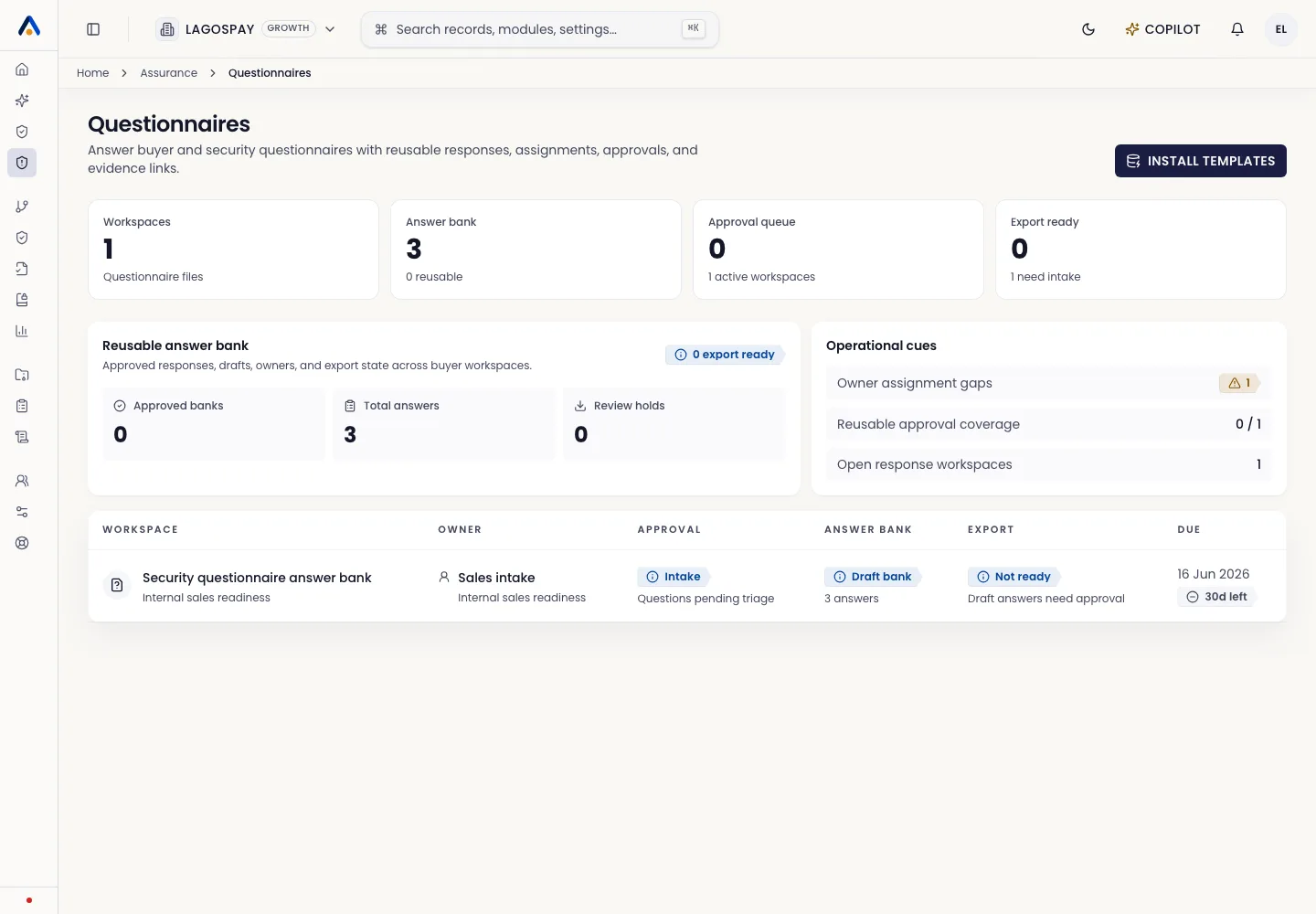
ASIRI helps your team move from knowing what to do to proving that the work is operating: records are assigned, evidence stays fresh, reviews are preserved, and audit-ready exports can be shared with buyers, DPCOs, management, or auditors.
These are the records a serious buyer, DPCO, auditor, or regulator will expect to see behind the claim.
ASIRI can organize workflows, evidence, review gates, and exports. Legal interpretation, regulator responses, DPCO submissions, and third-party certifications still require qualified human review and the relevant external authority.
Use it to brief your DPO, founder, procurement lead, or DPCO team on the evidence objects behind enterprise security questionnaire guide: owners, review dates, artifacts, blockers, and export expectations.
Asiri helps teams maintain buyer-ready evidence, Trust Centers, security packs, and answer workflows before the enterprise review starts.
Many do. A Trust Center can show current controls, documents, and readiness boundaries before formal third-party attestation is complete.
No. Public Trust Centers should expose enough to build confidence, while sensitive architecture, vulnerability, customer, and incident details stay gated.