

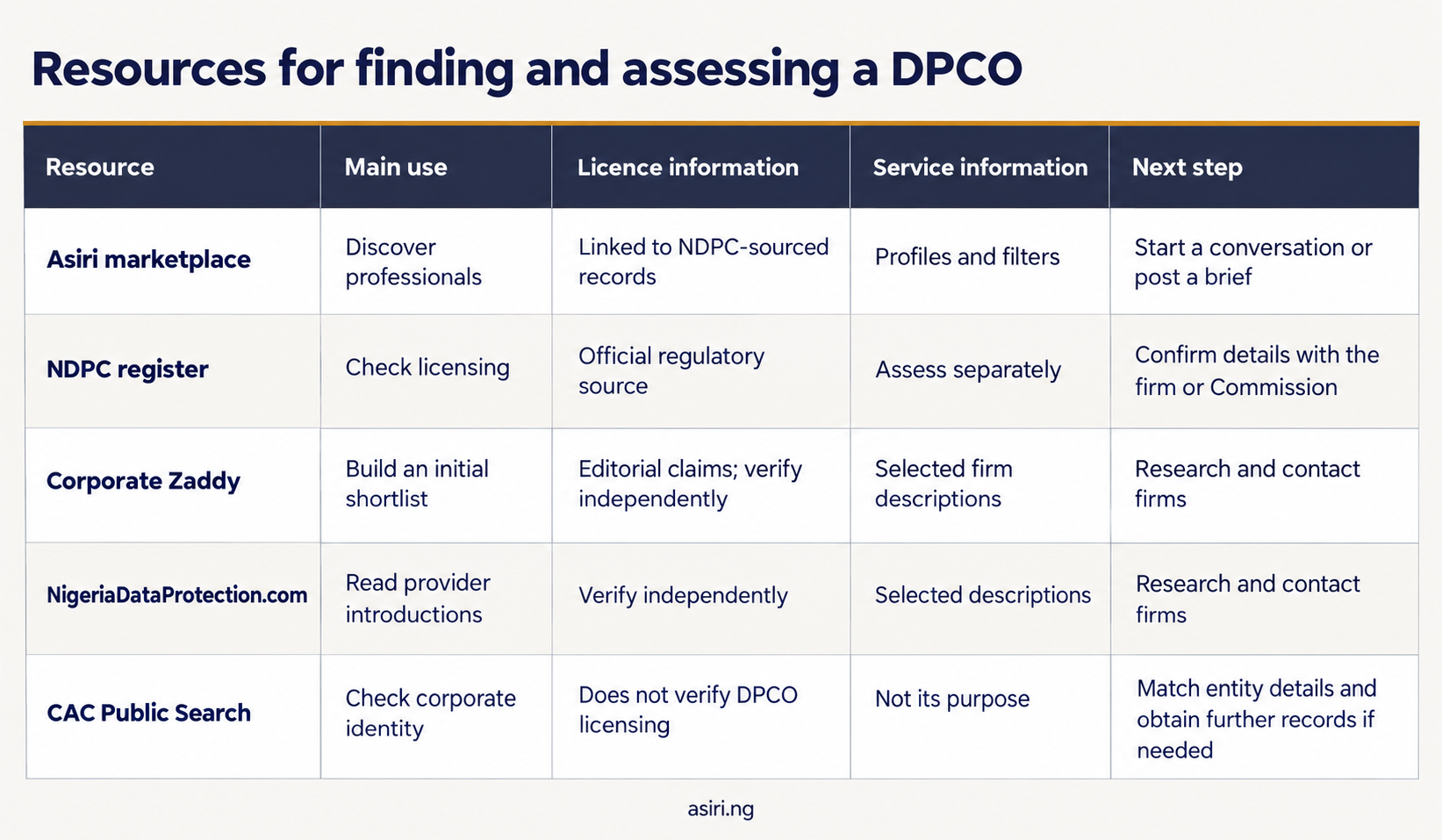
You can find DPCO firms through Asiri Compliance, the NDPC register and editorial provider lists. Use each resource for its intended purpose: discover firms, confirm licensing or check corporate identity before agreeing an engagement.
For banks, fintechs and other businesses, the useful question is whether a provider can deliver the work you need. This guide compares five resources and explains what to assess before choosing a firm.
Five resources for finding and checking Nigerian DPCOs
- Asiri Compliance marketplace: Discover DPCO firms and independent DPOs, explore profiles and begin a conversation.
- NDPC licensed-DPCO register: Check the regulator’s published licensing information.
- Corporate Zaddy DPCO list: Read editorial introductions to selected firms.
- NigeriaDataProtection.com: Explore provider introductions and data protection commentary.
- CAC Public Search: Cross-check a shortlisted firm’s corporate identity. This is a verification resource, rather than a DPCO directory.
How we compared these resources
These resources serve different purposes, so this is a practical comparison rather than an independently tested ranking. We reviewed their public pages for the information they provide and the next steps available to buyers.
Consider:
- Source of licence information: Is it the regulator’s record or a third-party description?
- Service information: Can you understand the provider’s offering before contacting them?
- Discovery options: Can you narrow the search to relevant services or locations?
- Contact route: Is there a way to begin a conversation or request a proposal?
- Currency: Can you establish when the information was checked?
Public browsing does not establish anonymous communication. Check what information a platform shares before sending an enquiry or uploading business records.
Five Nigerian DPCO discovery and verification resources
1. Asiri Compliance marketplace: finding professional support
The Asiri Compliance marketplace brings independent DPOs and DPCO firms into one place. You can explore profiles, filter by service, sector and location, and post a brief.
Features
- Professional profiles and service descriptions.
- Filters for narrowing your search.
- A licence-check route.
- Project briefs and conversations with professionals.
Pros: Discovery and enquiry options sit alongside provider information. The site states that nobody pays for placement and that practice order rotates for fair visibility. Every licence is confirmed by a human before being displayed on the marketplace.
Limitations: The marketplace does not replace direct a written engagement agreement. An independent DPO profile is not evidence of a DPCO licence.
2. NDPC licensed-DPCO register: checking the regulatory record
The NDPC licensed-DPCO repository is the regulator’s resource for licensing checks. Its public table includes fields for name, licence date, email, phone, state and status.
Features
- Licensing information published by the Commission.
- Firm identity and contact fields.
- A public route for checking a shortlisted provider.
Pros: This is the primary regulatory source. Use it when checking a firm’s claim to hold an NDPC licence.
Limitations: The register does not establish whether a firm has the experience, capacity or agreed scope for your engagement. If an entry is missing, unclear or inconsistent with the documents a firm supplies, seek clarification from the Commission.
3. Corporate Zaddy DPCO list: building an initial shortlist
Corporate Zaddy’s list of 20 DPCOs includes selected provider descriptions, contact information and corporate-registration details. Some entries also make claims about CAC annual-return status.
Features
- Introductions to selected firms.
- Service summaries and contact details.
- Hiring and verification guidance.
Pros: Editorial descriptions provide context beyond a company name and can help you identify firms to research.
Limitations: The article is a selected list, not the regulator’s full register. Treat licensing and corporate-filing statements as claims to verify independently. Its publication date does not establish that every entry remains current.
4. NigeriaDataProtection.com: provider introductions and advisory context
NigeriaDataProtection.com publishes data protection news and advisory articles, including an introduction to three DPCOs for MDAs.
Features
- Selected provider introductions.
- Commentary on professional support and data protection work.
- Context for readers researching the Nigerian privacy sector.
Pros: The articles can introduce firms you may want to research further.
Limitations: A recommendation written for an MDA does not establish suitability for a bank, fintech or SME. Provider descriptions are editorial information; confirm current credentials and relevant experience separately.
5. CAC Public Search: checking corporate identity
CAC Public Search helps you look up corporate-registration information. Use it to match the entity you intend to engage with the name on the proposal, contract and licensing record.
Features
- Entity searches using the official corporate registry.
- Registration information for identity checks.
- A way to investigate discrepancies in company names or numbers.
Pros: An official source for checking corporate identity.
Limitations: CAC registration does not establish DPCO licensing or service quality. Do not assume that a basic public-search result proves every annual return is current; obtain further records where your due diligence requires them.
What should you check before hiring a licensed DPCO in Nigeria?
Start with a clear description of the work. An audit, staff-training programme and ongoing advisory engagement need different deliverables.
Before signing, confirm:
- Credentials: The firm’s licensing position and legal identity.
- Relevant experience: Examples of work with organisations facing similar requirements.
- Scope: Deliverables, exclusions, deadlines and who will perform the work.
- Commercial terms: Fees, payment stages and responsibility for regulatory charges.
- Data handling: Information the firm needs, permitted access, confidentiality and arrangements for returning or deleting records.
- Handover: Reports, supporting evidence and outstanding actions your team will receive.
Keep a dated record of the checks and the final agreement. Reconfirm credentials if there is a significant delay before the engagement begins.
How does DPCO licensing work under the NDPA?
A Data Protection Compliance Organisation is a firm licensed by the NDPC to provide professional data protection services. These can include auditing, training and advisory work. Its licence does not guarantee the outcome of a particular engagement.
Registration renewal and Compliance Audit Returns (CAR) are separate obligations. Articles 9 and 10 of the final GAID 2025 explain that UHL and EHL organisations register once and file CAR annually, while OHL organisations renew registration annually and are not required to file CAR. UHL and EHL organisations must file CAR through a licensed DPCO unless the Commission approves otherwise.
Assess your organisation’s classification and applicable requirements before commissioning filing work. Avoid treating all financial-services businesses as belonging to the same category.
How Asiri Compliance supports your search
Use Asiri Compliance to identify potential partners, then discuss your requirements and agree the deliverables. Prepare a brief covering your business, the support needed, timing and the records available for review.
Asiri supports audit readiness; it does not conduct or file audits, replace a licensed DPCO or guarantee compliance.
Explore the marketplace and find support for your business.
FAQs about Nigerian DPCO directories and marketplaces
What is a DPCO, and why might my organisation need one?
A DPCO is a Data Protection Compliance Organisation licensed by the NDPC. Your business may need one for audit work, applicable CAR filing or specialist advice. Define the service required before choosing a provider.
How can I verify whether a DPCO is licensed?
Check the regulator’s published record and match the firm’s identity to its documents. Ask the NDPC to clarify discrepancies rather than relying on a directory description alone.
Can SMEs use these resources?
Yes. Smaller businesses can use them to research professional support. Choose an engagement proportionate to your activities and needs.
What is the difference between a directory and a marketplace?
A directory mainly provides listings. A marketplace also supports discovery or contact between buyers and providers. The available tools vary by platform.
Are there fees for using these resources?
Public information can be browsed without commissioning professional services. Check current platform terms and a provider’s proposal before assuming that an enquiry, listing or engagement is free.
How often is the NDPC register updated?
Do not assume a fixed update schedule unless the Commission publishes one. Check the record when making your decision and seek confirmation where the information is unclear.
About the author
Ebunoluwa Olawole
Ready to put the ideas into practice? Try the readiness check.