
01 / Clients you bring
You keep the relationship.
0%marketplace take
Bring the clients you already serve into a shared workspace. There is no marketplace deduction on those engagements.
Your client. Your agreed professional fee.
For licensed DPCOs and individual DPOs
Bring the clients you already serve onto Asiri. Request evidence, keep track of work and collaborate with each company in a workspace it authorises.
Free professional workspace. Companies pay for their software plans.
See when marketplace fees apply.

You bring the judgement. Asiri keeps the work together.
Client-owned records. Scoped professional access. Evidence alongside the work.
See the steps
Choose the walkthrough for a licensed DPCO firm or an individual DPO. See the claim or application, practice setup and public listing before you begin.
DPCO firm / Getting started
What you’ll see
Training videos use example practice details.
How client work moves
See how an evidence request moves between your practice and a client. The file, explanation and follow-up stay attached to the same piece of work.
One request · three connected moments
An illustrative example with fictional records. Each person acts within the company’s authorised workspace.
Client work / example
Please share the current processor agreement and confirm which services it covers.
Evidence requestedThe professional asks
The professional explains what is needed and when. The client sees the request in its own workspace.
The company knows exactly what to send.
Across your client portfolio
See your audits, the evidence behind the findings and what needs to happen next — across the clients you serve.
Inside the professional workspace
Product preview · example audit records
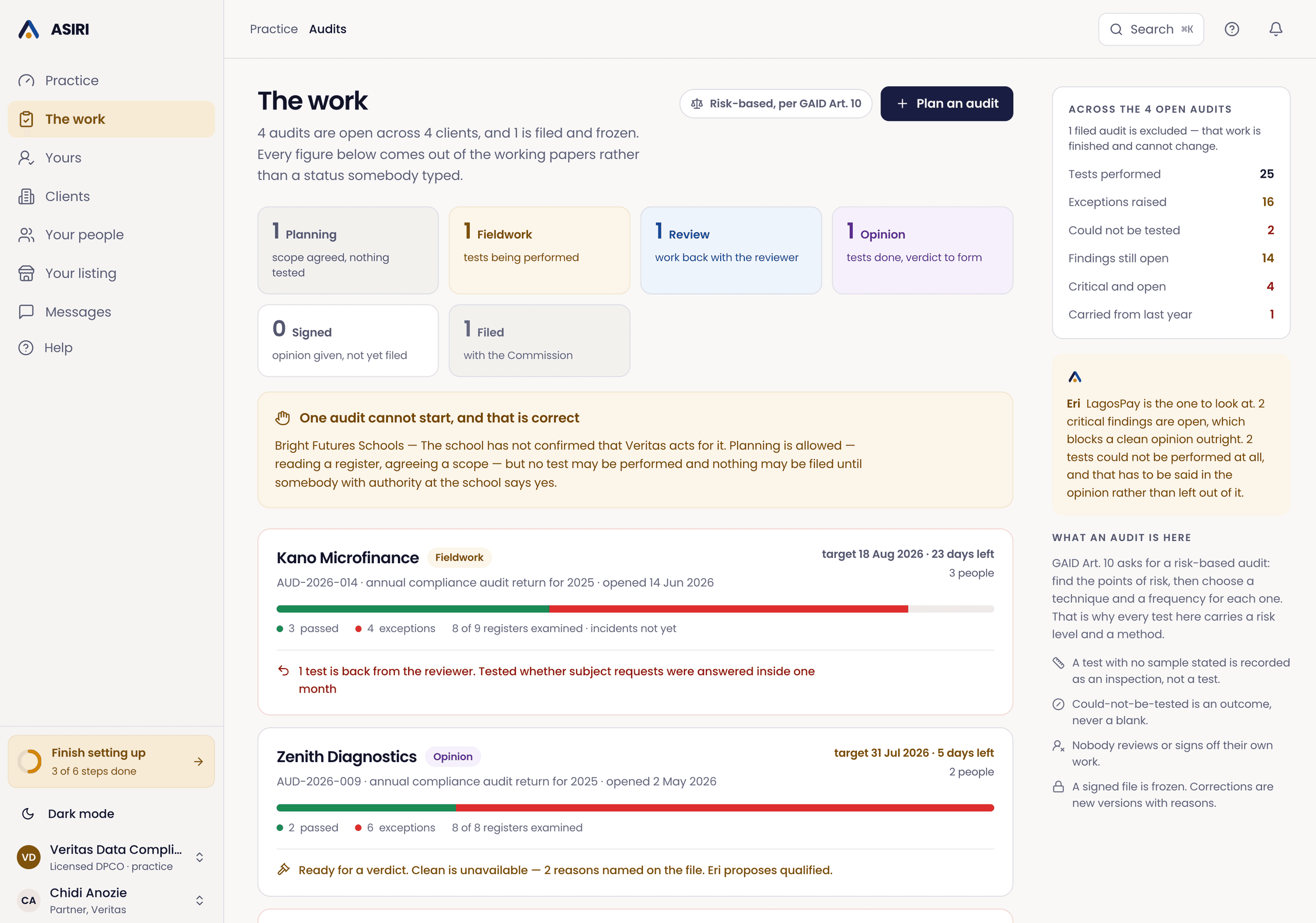
Scroll across to explore the workspace, or open the full screenshot.
Planning, fieldwork, review and opinion sit together, with filed work clearly separated.
Open findings, tests that could not be performed and reviewer follow-ups stay visible.
See when client authorisation is still needed before testing or filing can begin.
Bring your first client
Use your work email and firm details. Firms in the published register can claim their entry; individual DPOs apply through their own route.
Complete the required review and add the people who will prepare, review and sign work.
Agree the engagement scope. The company authorises access for the work and term it permits.
Request evidence, review the response and keep the supporting record alongside the work.
Your listing, engagement agreement and client access are separate steps. Get help with your first client →
Know what you pay
Keep the clients you already serve without a marketplace deduction. For new work you win through Asiri, see the rate, cap and your share before payment.
Your professional workspace is free.
No joining, listing or per-client access fee.
Companies pay for their own software plans and authorise your access.
01 / Clients you bring
Bring the clients you already serve into a shared workspace. There is no marketplace deduction on those engagements.
Your client. Your agreed professional fee.
02 / Clients from Asiri
Standard engagement · capped at ₦100,000 per engagement.
Asiri introduces the client.
Eligible renewals: 2.5%, capped at ₦30,000.
Your first 3 paid wins: no marketplace take for an eligible professional.
Standard marketplace engagements · examples
Examples show the marketplace take only, before any other applicable payment charges. Brought-in clients and eligible introductory engagements follow their own terms.
No marketplace take applies to statutory fees. These are separate from the professional fee. Asiri’s take includes VAT.
The engagement’s terms identify the applicable fee before payment. Marketplace payments are split by the payment processor as they are collected; your share settles to your bank on the processor’s schedule.
An additional route to new clients
Publish your scope and exclusions, answer prospective clients’ questions and respond to relevant briefs. Agree the work before you price it.
Explore the marketplace →Every scope you publish carries its exclusions, and the boundary refuses one without them. It is the least comfortable thing on this page and the most useful: a job you did not exclude is a job you agreed to, and the exclusions are the part buyers actually read.
A buyer can open a room and ask what you would exclude, who does the work, and whether they need you at all — before anybody prices anything. You see their sector and their question. Whoever answers with something useful rather than a brochure tends to be the one asked for the price.
A company describes a job once and every practice claiming that sector can bid. The sector on your listing is what puts it in front of you — not your licence, and never a payment, because there are no paid leads here to buy. A bid carries a scope and no figure.
Eight clauses, each carrying why it exists, and no annex. You draft it, the buyer can query any clause — which blocks the signature until you answer — and both signatures start the engagement. Neither of them opens a register.
A buyer authorises you by having somebody at their company read a single-use code back to you. Fifteen minutes, one use. It is more friction than a button and it is the reason a controller is willing to let a stranger near their registers at all.
Your licence standing and your delivery record are read off the register and computed from closed jobs — you cannot edit either, which is the only reason a buyer believes them. How fast you answer is the one signal that moves within a day.
Professional standards
Nobody polls the Commission — it publishes a portal a person reads, not an interface. So a check is somebody looking, recording what they saw and keeping the capture, and that reading stands for 90 days. The expiry date on it is what Asiri counts down to, because a lapsed licence cannot file.
A note to you alone· nothing shows on your public profile. Any engagement whose filing date falls after the expiry is flagged to both sides, because an awkward call now beats a blocked return later.
The same note, once more, and then it stops. A warning that goes on repeating past the point of use is a warning people learn to file unread.
You keep your workspace and your history. Your listing stays up carrying the lapse rather than quietly disappearing — a buyer should hear it from the page, not from you — and you can still advise, be engaged and do the work. What you cannot do is file a return or sign an audit opinion, so a job that ends in a filing needs a licensed firm for that step until the register says current again.
Nigeria's market is small and a blanket ban would just push the arrangement off-platform. So Asiri raises it in the three places it matters — on the engagement, on your public profile, and inside the filing pack — and lets the client decide with their eyes open.
Named at the point of acceptance, so nobody discovers it three weeks in.
Prior remediation work shows alongside audit work. Buyers see the whole relationship.
Disclosed where a regulator would look for it, rather than left to be found.
Nobody signs off their own testing. That one is a hard stop, not a disclosure.
The company controls professional access. Nobody signs off their own testing, and Asiri does not replace professional judgement.
Start with the clients you know
Set up your professional workspace, or talk through onboarding with us first.