

Nigerian fintechs face a trust problem that global compliance tools were not built to solve. Your buyers, your regulator, and your auditor all want evidence that you handle personal data according to Nigerian law. The NDPA 2023 changed the rules for every business that processes personal data in this market, and the tools designed for London or San Francisco treat Nigerian privacy operations as an add-on at the end of a configuration menu. Trust center software gives you a public or gated portal where enterprise buyers, investors, and regulators can access your compliance posture, certifications, and security documentation on their own terms.
For Nigerian fintechs, the question is not whether to have one. The question is which platform can anchor NDPA readiness, evidence provenance, and buyer assurance in a single workspace, rather than forcing you to bolt Nigerian obligations onto a foreign framework.
This article compares trust center software and compliance portals through the lens that matters to your compliance team: audit evidence management, security documentation sharing, local regulatory fit, and buyer trust workflows. ASIRI Compliance built its Trust Center feature around NDPA operations from the first line of code, so the comparison criteria reflect the reality of Nigerian fintech compliance rather than a generic global checklist.
How We Evaluated Trust Center Software for Nigerian Fintechs
Evaluation criteria need to reflect what your compliance team actually faces: NDPC compliance audit returns, cross-border data transfers, lawful basis mapping, breach response documentation, and enterprise buyer due diligence requests. We scored platforms across five dimensions.
- NDPA regulatory fit: Does the platform include workflows for RoPA, DSR management, DPIA, lawful basis, consent tracking, and breach notification tied to the NDPA, or does it depend on custom fields and workarounds?
- Audit evidence management: Can the platform collect, store, and export evidence with provenance, meaning every record links back to the system that produced it and the date it was observed?
- Trust center quality: Does the buyer-facing portal show live compliance status, gated assets, access analytics, and reusable answers to security questionnaires?
- Framework coverage: Does the platform map the same evidence across NDPA, SOC 2, ISO 27001, PCI DSS, and GDPR, or does each framework require separate documentation?
- Deployment and data residency: Can the platform keep data in an African region, and does it support deployment models that respect Nigerian data residency expectations?
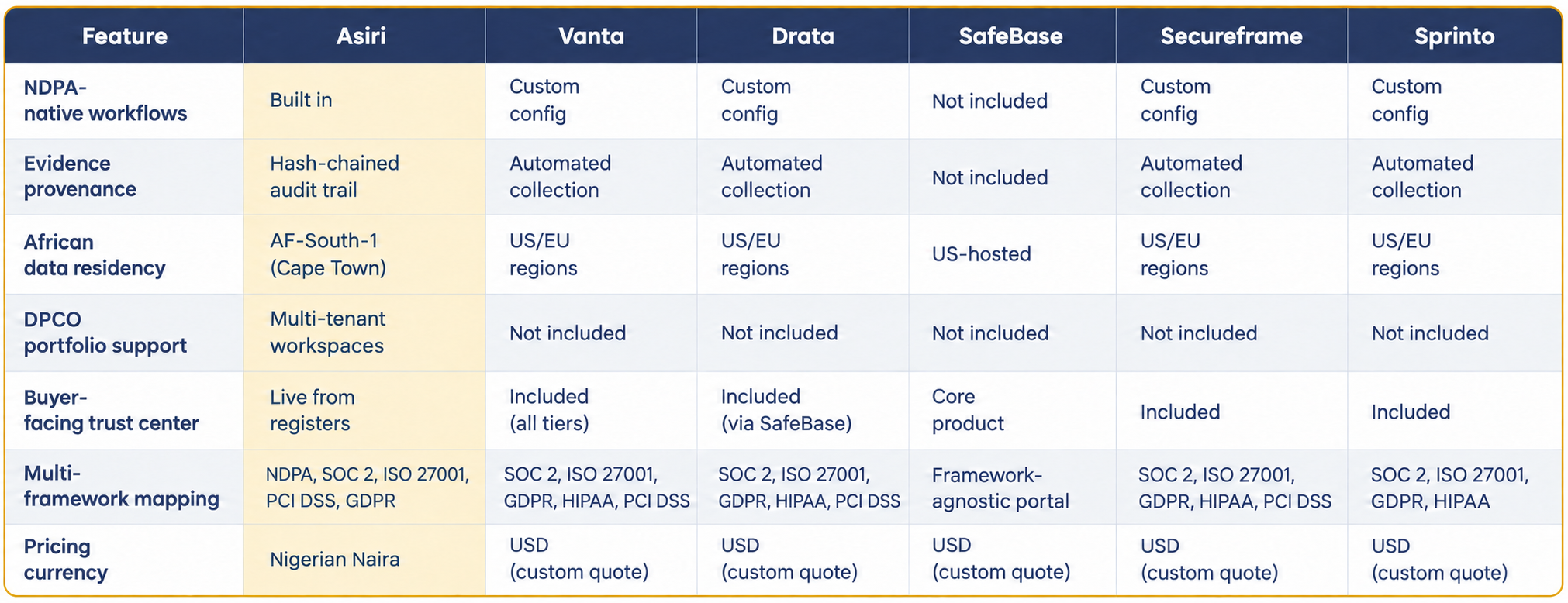
1. ASIRI Compliance
Asiri is built around NDPA operations from the ground up. Where global platforms require you to configure custom fields for lawful basis mapping, RoPA, and DSR management, Asiri includes these as core workflows. The Trust Center publishes readiness status from your live compliance registers, so what buyers see is backed by dated, verifiable evidence rather than a static document library.
Evidence provenance is a defining feature. Every register figure links back to the system read that produced it and the date the observation was recorded. The evidence vault stores compliance artifacts in an append-only audit trail that cannot be altered after the fact. When your auditor asks for evidence, each record carries a named owner, a reviewer action, a due date, and a full activity history.
For Nigerian fintechs, the DPCO portfolio support stands out. Licensed Data Protection Compliance Organizations can run their entire client book on the platform, with tenant-scoped API keys, workspace billing isolation, and scoped engagements authorized through single-use codes. That operational model does not exist on global platforms.
Asiri maps controls across NDPA, SOC 2, ISO 27001, PCI DSS, and GDPR, so you reuse the same evidence across multiple frameworks. The Live Compliance Score calculates a real-time view of your compliance posture. Pricing is denominated in Nigerian Naira, which eliminates foreign-exchange exposure on your compliance obligations.
Pros (Why to choose Asiri):
- NDPA workflows built in, not bolted on: RoPA, DSR, DPIA, breach, consent, and cross-border transfers
- Hash-chained, tamper-evident audit logs with evidence provenance
- African data residency (AF-South-1, Cape Town)
- DPCO multi-tenant workspace for portfolio management
- Pricing in Naira with no forex exposure
Limitations:
- Newer entrant with a smaller footprint compared to established global incumbents
- Primary focus on Nigerian and African markets means fewer pre-built integrations for US-only SaaS stacks
2. Vanta
Vanta is one of the more established compliance automation platforms, with over 2,000 reviews across third-party platforms and a large integration ecosystem of 400+ connectors. The trust center is included in all plan tiers, and the advanced version adds an AI chatbot that answers buyer questions from your own documentation.
Vanta covers SOC 2, ISO 27001, HIPAA, GDPR, and PCI DSS with ongoing monitoring and automated evidence collection. CRM integrations tie security reviews to pipeline data, and NDA collection can run through DocuSign or Ironclad.
For Nigerian fintechs, the gap is NDPA operational coverage. Vanta does not include native NDPA workflows for lawful basis, RoPA, DSR, or DPCO portfolio work. Teams that need to meet NDPC Compliance Audit Return requirements will need to configure custom fields, build manual processes, or layer local workflow tooling on top of the platform. Data hosting is US/EU only, with no African region available.
Pros:
- 400+ integrations and ongoing monitoring
- AI chatbot on the trust center for buyer self-service
- Strong track record with mid-market SaaS companies
Limitations:
- No native NDPA workflows; requires custom configuration for Nigerian compliance
- US/EU hosting only; no African data residency option
- Per-seat pricing model, quoted in USD
3. Drata
Drata positions itself as a compliance automation platform with ongoing monitoring across SOC 2, ISO 27001, GDPR, HIPAA, and PCI DSS. In early 2025, Drata acquired SafeBase, adding a dedicated trust center product to its suite. The combination gives you compliance automation and a buyer-facing portal in one vendor relationship.
Drata automates evidence collection and offers 500+ integrations. The platform covers control monitoring and risk assessment. Post-acquisition, the SafeBase trust center adds document-level audit trails, access analytics, and NDA gating.
The Nigerian fintech consideration is the same as Vanta: no native NDPA workflows, no African data residency option, and pricing denominated in USD. Implementation is oriented toward teams with budget and headcount for a global compliance program. If your operating anchor is NDPA readiness and DPCO evidence, Drata requires significant local customization.
Pros:
- Broad integration ecosystem (500+ connectors)
- SafeBase trust center is now bundled in the platform
- Ongoing control monitoring across multiple frameworks
Limitations:
- No NDPA-native workflows or African data residency
- Post-acquisition pricing is opaque and requires a sales conversation
- Designed for teams running a US or EU-led compliance program
4. SafeBase
SafeBase is a standalone trust center product, now operating under Drata. It focuses on the buyer portal experience: a searchable Trust Library, granular document access with full audit trails, multi-product profiles, and NDA gating. SafeBase does not include compliance automation, evidence collection, or framework monitoring.
For teams that already have compliance infrastructure in place and need a polished buyer-facing portal, SafeBase offers a focused solution. The platform counts major enterprise names among its users, and the document-sharing workflows are more refined than trust centers bundled inside compliance platforms.
Nigerian fintechs will find that SafeBase handles the publishing layer well but does not help you collect, map, or verify the underlying evidence. There are no NDPA workflows, no lawful basis mapping, and no DPCO support. You would need a separate platform for Nigerian compliance operations and then publish the output through SafeBase.
Pros:
- Purpose-built trust center with document-level access tracking
- Multi-product trust center profiles
- AI-assisted questionnaire responses
Limitations:
- Trust center only; no compliance automation, evidence collection, or framework mapping
- No NDPA workflows or African data residency
- Requires a separate compliance platform for evidence management
5. Secureframe
Secureframe covers compliance automation, trust center, and questionnaire automation in a single platform. The company reports 6,000+ organizations using its product, and its team includes 30+ in-house compliance professionals and former auditors. Secureframe supports SOC 2, ISO 27001, GDPR, HIPAA, PCI DSS, and FedRAMP.
The trust center lets you share compliance status with buyers, and the AI-powered questionnaire tool handles inbound security reviews. Evidence collection and ongoing monitoring run across connected systems.
For Nigerian fintechs, Secureframe has the same gap as other global platforms: no native NDPA coverage, US-hosted infrastructure, and USD-based pricing. If your primary framework is SOC 2 or ISO 27001 and Nigerian compliance is secondary, Secureframe covers that scope. If NDPA evidence and DPCO workflows are your operating anchor, you will need additional tooling.
Pros:
- Track record of 6,000+ organizations
- In-house compliance professionals for guidance
- Covers SOC 2, ISO 27001, GDPR, HIPAA, PCI DSS, and FedRAMP
Limitations:
- No NDPA-native workflows or African data residency
- Custom quote pricing in USD
- Trust center feature depth focused on global frameworks
6. Sprinto
Sprinto is a compliance automation platform with a trust center that activates quickly and includes NDA gates, expiry links, and access tracking. The platform covers SOC 2, ISO 27001, GDPR, and HIPAA with 300+ integrations. It has a 4.8/5 rating across 1,500+ reviews on G2.
For startup-stage fintechs pursuing their first SOC 2 or ISO 27001, Sprinto offers a competitive starting point. The trust center is included in every plan, and evidence collection runs across AWS, Okta, and Google Workspace.
Nigerian fintechs face the same constraint: no native NDPA coverage, no African data residency, and no DPCO portfolio management. Sprinto works well as a SOC 2 and ISO 27001 starting point, but you will need Nigerian-specific tooling for NDPA operations, NDPC filings, and local buyer assurance.
Pros:
- 300+ integrations with automated evidence collection
- Trust center included in base plan
- Competitive entry point for first-time compliance programs
Limitations:
- No NDPA workflows or African data residency
- Questionnaire automation is less developed compared to standalone tools
- Pricing not publicly available; requires a sales call
What Nigerian Fintechs Should Evaluate First
Trust center software is worth your investment only if the underlying compliance evidence is current, traceable, and reviewable. A polished portal that publishes stale PDFs or unverified compliance claims does not protect you when a buyer, auditor, or the NDPC comes asking questions.
Does the platform map to NDPA obligations? RoPA, lawful basis, DSR handling, DPIA, consent management, breach notification, and cross-border data transfer documentation are core requirements for any Nigerian fintech. If the platform treats these as custom configurations rather than built-in workflows, your team will spend time building what should already exist.
Can you trace every piece of evidence back to its source? Audit readiness requires provenance. Each record should link to the read that produced it, the date it was observed, and the person who owns it. Asiri's audit trail feature uses hash-chained logs and signed evidence exports for exactly this purpose.
Does the trust center reflect live compliance data? A trust center that draws from your operational registers shows buyers dated, verifiable readiness status. A trust center that hosts static uploaded documents creates a gap between what you publish and what your systems actually show.
Where does your compliance data live? Nigerian fintechs handling personal data under the NDPA need to understand where their compliance records are hosted. Asiri offers data residency in AF-South-1 (Cape Town), which is relevant for teams that need to keep records on the African continent.
How Asiri Compliance Fits Your Nigerian Fintech Compliance Stack
Asiri is built for the Nigerian operating model. NDPA workflows are native. Evidence provenance is built into every record.
- The Trust Center generates content from your live registers rather than static document uploads. That design choice means what you publish to buyers is backed by the same evidence your auditor and your DPCO review.
- The Fintech Compliance module delivers privacy and regulatory workflows tailored to fintechs and financial services. Controls map to NDPA, SOC 2, ISO 27001, PCI DSS, and GDPR, so you collect evidence once and reuse it across frameworks. The platform blocks filing when high-residual-risk items or required fixes remain outstanding, which prevents your team from submitting returns with gaps that could draw regulatory scrutiny.
- The DPCO/DPO Marketplace connects you with vetted Data Protection Compliance Organizations who specialize in NDPA. If you are a licensed DPCO managing multiple client engagements, the multi-tenant workspace lets you run your entire book on one platform with scoped access controls and isolated billing.
- Asiri is priced in Naira plus a free plan to see if it works for you. Your compliance budget does not swing with currency fluctuations. And the platform is Nigeria-first by design, not by accident.
Frequently Asked Questions about Trust Centers for Fintechs in Nigeria
What is trust center software, and why do Nigerian fintechs need it?
Trust center software creates a public or gated portal where enterprise buyers, auditors, and regulators can access your security posture, certifications, policies, and compliance documentation. Nigerian fintechs need trust center software because the NDPA requires demonstrable evidence of data protection readiness, and enterprise buyers increasingly expect a self-service portal rather than back-and-forth email exchanges during procurement due diligence.
Can global trust center platforms handle NDPA requirements?
Global platforms such as Vanta, Drata, Secureframe, and Sprinto cover frameworks like SOC 2, ISO 27001, and GDPR. They do not include native NDPA workflows for lawful basis mapping, RoPA, DSR management, DPIA, breach notification, or DPCO portfolio work. Nigerian fintechs using these platforms typically need custom configurations or additional tooling to cover NDPA obligations.
How does evidence provenance differ from automated evidence collection?
Automated evidence collection pulls data from connected systems and stores it. Evidence provenance goes further: each record links to the specific system read that produced it, the timestamp of the observation, the named owner, and the reviewer action. Asiri uses hash-chained audit logs that cannot be altered, giving your auditor a tamper-evident record of every compliance artifact.
What should a Nigerian fintech look for in a trust center?
Start with NDPA-native workflows: RoPA, lawful basis, DSR, DPIA, consent, and breach documentation. Check whether the trust center publishes live compliance data from your operational registers or hosts static documents. Evaluate evidence provenance, multi-framework mapping, African data residency options, and whether pricing is denominated in Naira to avoid forex exposure on compliance spend.
Does Asiri Compliance issue SOC 2 or ISO 27001 certificates?
No. Asiri prepares your team, collects evidence, maps controls, and publishes readiness status. SOC 2, ISO 27001, and other attestations are issued by independent auditors and certification bodies. That boundary between readiness and third-party attestation is fundamental to how Asiri operates.
About the author
Ebunoluwa Olawole
Ready to put the ideas into practice? Try the readiness check.