
A Data Protection Officer (DPO) is the person appointed to advise on and monitor an organisation’s data protection work. A Data Protection Compliance Organisation (DPCO) is an organisation licensed by the Nigeria Data Protection Commission (NDPC) to provide professional data protection compliance services.
For a business comparing DPCO vs DPO support, the distinction affects what you buy, who you work with and how the work continues after an engagement ends. You might need someone who stays involved as your business changes, a firm to carry out a defined assignment, or a combination of both.
Imagine a growing Nigerian retailer. Customers place orders through WhatsApp, staff enter delivery details into a spreadsheet, and dispatch riders receive the information needed to deliver packages. Payroll sits in another system, while marketing contacts are managed by a different team.
The owner knows these records need attention but is unsure whom to approach. One proposal offers outsourced DPO support. Another offers a compliance review, staff training and audit services. Both concern data protection, yet the commitments are different. Understanding those differences makes it easier to compare the proposals and choose support that fits the work.
What is a DPO?
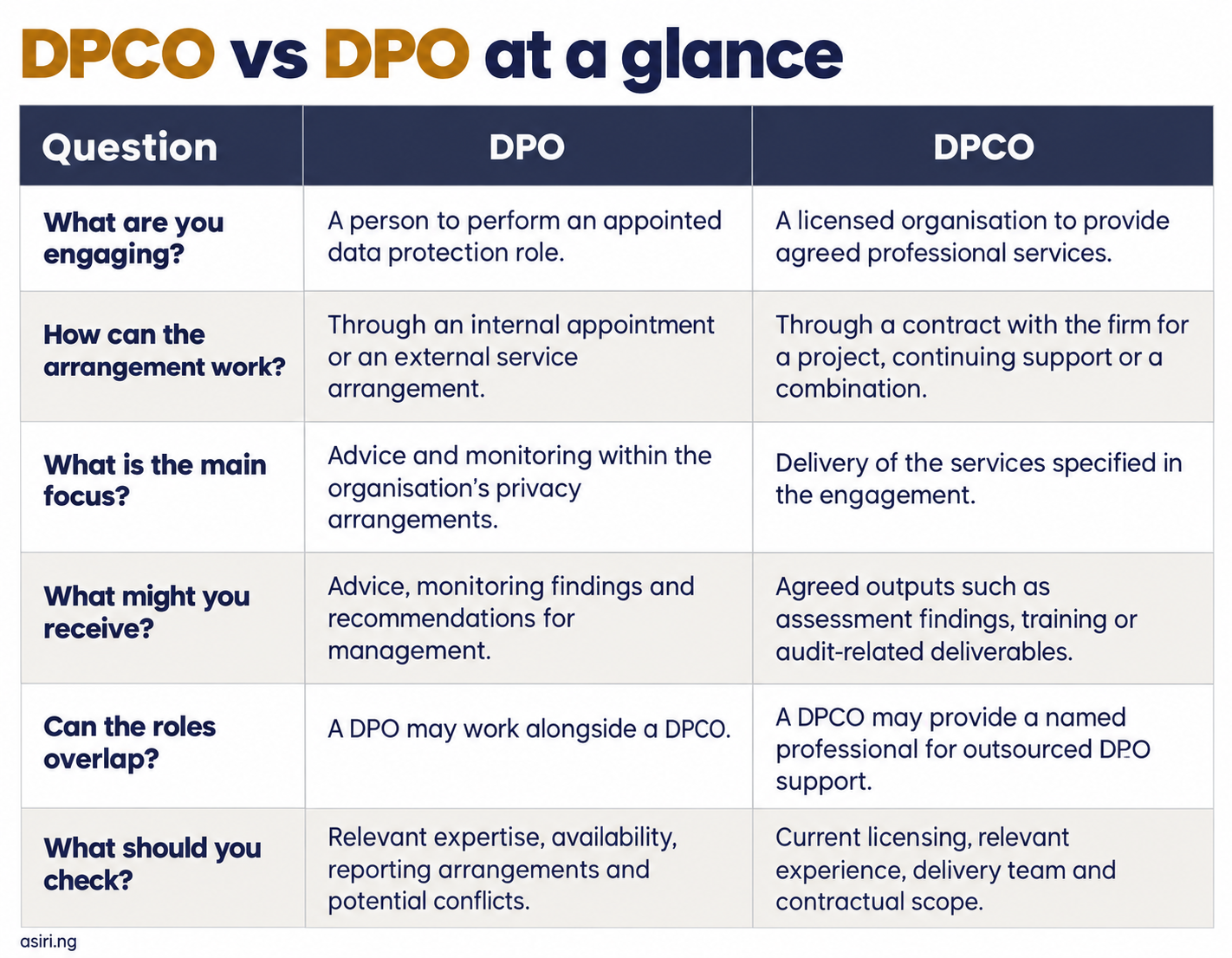
DPO stands for Data Protection Officer. This is an appointed role within your organisation’s privacy arrangements, even where the person providing the service works externally. The DPO helps your business understand its obligations, monitors its approach to compliance and advises the people handling personal data. The role also provides a contact point for privacy matters.
In practice, your DPO might ask why a checkout form collects a date of birth, advise on a customer’s request for their information, or raise concerns about a supplier receiving more records than it needs. They need enough understanding of the business to connect privacy advice to real decisions.
That does not mean the DPO performs every task personally. HR still manages employment records. IT still implements technical controls. Customer service still needs to recognise and route requests. Management still makes decisions and provides resources.
The value of the role depends partly on when the person is involved. A DPO who learns about a new customer platform only after launch has fewer opportunities to help the team address problems before information starts moving through it.
Implementation guide: Before appointing someone, describe how the role will work. Identify the management contact, the teams they will need to speak with and the changes they should hear about early. Give the appointment a practical place in your workflows.
What is a DPCO?
DPCO stands for Data Protection Compliance Organisation. The NDPC licenses these organisations to provide services such as training, auditing and consulting. A DPCO engagement can bring together several kinds of expertise. Depending on the agreed scope, a firm might review your processing activities, help assess gaps, deliver staff training or provide support for an applicable compliance audit and return.
The firm’s licence and your contract answer different questions. Licensing establishes its status as a DPCO. The contract establishes what it has agreed to do for your business, who will deliver the work and what you should receive.
For example, a proposal to review a privacy notice may cover the wording and the information supplied by your team. It may not include interviews with every department, a full supplier review or ongoing advice after the notice is delivered. Those details need to be agreed rather than assumed.
A DPCO may also offer outsourced DPO services. In that arrangement, ask who will perform the DPO role and how they will work with your organisation. Engaging the firm for a separate project does not, by itself, establish a DPO appointment.
Implementation guide: Ask the firm to explain its deliverables in business terms. “Compliance support” is too broad to compare. A proposal should make clear which activities are covered, what information you must supply and how the findings will be handed over.
What does each do for your business?
Think about a business introducing a loyalty programme. The marketing team wants to record purchases, send offers and learn which customers return most often.
- The DPO can advise the team as it plans the programme: what information is necessary, how customers will understand the uses, which suppliers are involved and what choices need to be managed. The team then carries out the agreed actions and brings unresolved questions back for advice.
- A DPCO could be engaged for a defined piece of work around the same programme. That might involve reviewing the proposed data flows, supporting an assessment or training staff before launch. Its involvement depends on the services commissioned.
Neither arrangement becomes useful simply because a document has been delivered. If a recommendation requires a change to the checkout form, someone with responsibility for that form must implement it. If a supplier agreement needs attention, procurement or management must take the next step. This is why responsibilities should be discussed at the start. Ask who provides advice, who approves decisions, who changes systems and who checks progress. The answer may involve several people, including both your appointed DPO and an external firm.
**Note: It also helps to distinguish routine advice from specialist work. A question about an everyday form may fit within an ongoing arrangement. A complex incident, a new international service or a substantial assessment may require additional expertise and a separate scope. Check the proposal before assuming everything is included.
How can a DPO and DPCO work together?
Consider a fictional delivery business preparing for an external review. Its appointed DPO understands the order process, the tools staff use, and the gaps already raised with management. The business engages a licensed DPCO for an agreed review and applicable audit support.
- The DPO helps explain the existing records and connects the firm with the right teams. Operations describes how delivery details reach riders. HR explains staff records. IT explains accounts and permissions. The firm reviews the evidence within its scope and presents its findings.
- Afterwards, management assigns the resulting actions. Some may need budget approval; others may involve changing access, updating a notice or clarifying a supplier arrangement. The DPO can monitor follow-up, while the firm provides any additional support agreed in its contract.
This example shows why continuity matters. A report can identify issues, but your business needs a way to act on them after the review ends. Equally, an ongoing DPO arrangement does not remove the need for separately required or commissioned professional work.
Where one provider offers several services, discuss how it handles potential conflicts. Ask how concerns will reach management and how the quality of the work will be reviewed. The purpose is to understand the arrangement before relying on it.
Implementation guide: Keep a shared action record after an engagement. Include the finding, the business owner, the next step and the evidence needed to close it. That gives the DPO, the firm and management a common view of progress.
What do businesses commonly misunderstand?
- Hiring a DPCO means the business now has a DPO. That depends on whether DPO services were included and an appointment was properly established. A contract for staff training or an audit project answers a different need.
- A DPO must always be a full-time employee. External arrangements are possible, but availability still matters. Ask how the person will learn about business changes, respond to questions and maintain a useful relationship with your team.
- Treating a certificate as sufficient evidence of suitability. Training and professional credentials matter, but you should also examine relevant experience and the person’s ability to work with your organisation. Individual credentials do not establish that a firm holds a DPCO licence.
- Privacy belongs entirely to IT. Technology is part of the work, but decisions about recruitment, marketing, customer service and suppliers involve other teams. A secure system does not explain whether a form needs every field or whether a former employee’s records should still be retained.
- Paying for support transfers all responsibility away from the business. Your organisation still needs to make informed decisions, provide accurate information and carry out agreed actions. A recommendation cannot change a workflow unless the people responsible act on it.
These misunderstandings often surface when proposals use broad language. Ask providers to explain what the service will look like during a normal working month. Concrete examples make it easier to see whether the offer matches your needs.
How do you choose the support you need?
- Start with the problem you are trying to address. Perhaps nobody coordinates privacy questions across the business. Perhaps you already have a DPO but need specialist help for a defined assignment. Perhaps you have records scattered across departments and need an initial assessment before deciding on continuing support.
- Write a short brief covering your activities, systems, existing support and immediate concerns. A clinic might describe patient booking and record access. A retailer might describe online orders and delivery partners. A software business might describe customer accounts and overseas providers. These details help a professional understand the work beyond your industry label.
- Assess appointment and other regulatory requirements against the NDPA and current NDPC guidance. The Act expressly addresses DPO appointments for organisations of major importance, and GAID provides further appointment direction. Avoid deciding from staff numbers alone or assuming that another company’s arrangement will suit yours.
- When comparing DPO support, ask who will perform the role, what access they need, how they report concerns and whether they have enough capacity. Invite them to explain how they would approach one familiar problem in your business. A clear explanation can reveal how well they communicate with non-specialists.
- When comparing DPCOs, verify current licensing through official NDPC resources. Then assess the proposed team, experience and scope. Ask for the deliverables, exclusions, expected timeline and information your staff must provide. Clarify professional fees, any separate regulatory payments and what follow-up costs extra.
- Discuss confidentiality and access before sharing records. Where a sample will do, agree how to provide one safely. For payroll, customer or patient information, establish who needs access and how the material will be handled during and after the engagement.
- Also ask about handover. Your business should understand the findings and know how to continue the work if the engagement ends or the named professional changes. An accessible action list and a clear explanation of outstanding questions are useful parts of that conversation.
Implementation guide*: Compare proposals against the same brief. If one covers a short assessment and another includes continuing DPO support, separate those elements before evaluating cost. Choose on the work and access your business will receive.*
Find suitable support through Asiri Compliance
The Asiri marketplace helps businesses discover independent DPOs and DPCO firms, explore expertise and compare listed services. You can use its service, sector and location filters to narrow your search and start a conversation about your needs.
Bring your brief into that conversation. Explain what needs attention, ask who would deliver the work and agree the scope before proceeding.
Asiri supports the search for professional expertise and the organisation of privacy work. It does not replace your appointed DPO or licensed DPCO, conduct or file audits, or guarantee compliance.
Identify the support your business needs and explore the Asiri marketplace; a better starting point for choosing the person, firm or combination that fits your business.
About the author
Ebunoluwa Olawole
Ready to put the ideas into practice? Try the readiness check.