

Nigerian fintech and SaaS teams face a specific challenge when an enterprise buyer, an investor, or the NDPC asks: "Show us your compliance management software and the evidence behind it." The request is never about policy documents alone.
Buyers want dated proof that your data protection controls operate the way you say they do. Choosing the right platform to centralize that evidence and stay audit-ready under the Nigeria Data Protection Act (NDPA) 2023 can shorten your sales cycle.
This article compares six platforms and explains what to look for when the law you answer to is Nigerian, not European.
Asiri built its platform around the NDPA from the first line of code. The other five platforms on this list approach the same problem from different directions, and each brings something worth understanding before you commit.
Quick guide: 6 best compliance evidence management platforms for Nigerian teams
- Asiri: The best NDPA-native compliance hub for Nigerian fintech and SaaS audit readiness
- Vanta: Broad integration library for cloud-native teams managing SOC 2 and ISO 27001 programs
- Drata: Multi-framework automation with an integrated trust center for growth-stage SaaS
- Sprinto: Compliance automation mapped to 200+ standards with AI-driven evidence collection
- Secureframe: Custom control support for teams with on-premises and hybrid infrastructure
- SafeBase: A trust center platform focused on buyer-facing security documentation and NDA management
How we chose the best compliance platforms for Nigerian audit readiness
We evaluated each platform against criteria that matter when your regulatory obligations start with the NDPA and extend outward to global frameworks. A tool designed for SOC 2 in San Francisco will not know that a licensed DPCO must file your annual registration renewal.
- NDPA alignment: Does the platform map controls to the Nigeria Data Protection Act, or does it treat Nigerian law as an add-on to GDPR?
- Evidence provenance: Can every figure in your compliance register link back to the system read that produced it, with a timestamp showing when it was observed?
- Audit workflow support: Does the platform help assemble working papers and filing packs, or does it stop at the controller's side of the audit?
- Trust center publishing: Can you publish a buyer-facing page generated from your live registers rather than a static PDF?
- Vendor risk management: Does the platform track sub-processors, cross-border transfers, and vendor security posture in a way your procurement team can act on?
- Data residency: Where does the platform store your compliance data, and can you keep records in an African region?
- Multi-framework mapping: Can the same evidence satisfy requirements across NDPA, SOC 2 Type II, ISO 27001, PCI DSS, and GDPR without duplicating work?
The 6 best compliance evidence management platforms for Nigerian teams
1. Asiri: Best overall compliance hub for Nigerian audit readiness
Asiri is Nigeria-first by design, not by accident. The platform was built around the NDPA from the first line of code, so the workflows, the language, and the evidence all map to the law you are actually governed by.
Where other platforms bolt Nigerian requirements onto European frameworks, Asiri starts from the Act itself. The platform works outward to SOC 2 Type II, ISO 27001, ISO 42001, PCI DSS, and GDPR.
Asiri keeps your NDPA registers in plain language and shows a compliance score where every deduction is named. The platform connects to your existing systems and shows provenance for every answer.
A number you told Asiri is distinguished from a number Asiri read from your production environment. That distinction matters when an auditor or a regulator reviews your file.
Asiri assembles the filing pack your licensed DPCO needs to sign. The submit control is absent for anyone who is not a licensed firm, and filing is blocked while critical findings remain open.
That boundary between readiness and the audit opinion is fundamental to how Asiri operates. It applies to every workspace on the platform.
Asiri features
- Automated evidence collection: Asiri connects to AWS, Google Workspace, GitHub, Okta, Jira, and Linear to pull compliance evidence directly from your systems. Each record carries a provenance marker showing whether it was verified, declared, or missing.
- NDPA-native audit workflows: The platform builds audit working papers from your operational registers. Scope, materiality, fieldwork, findings, and the signed opinion all live in one workflow rather than scattered across spreadsheets.
- Live Compliance Score: A real-time score calculated as 100 minus what is provably wrong, with each deduction named. The score updates as you remediate, so you can see your position before you spend anything.
- Trust Center publishing: A public page at your URL, generated from the registers you keep for the Commission. Badges show whether a standard is managed, self-assessed, or still under way. Buyers can request documents or ask questions, and both land in a register with a clock. Available on every plan, including the free plan.
- Multi-framework evidence mapping: Seven frameworks are managed, mapped requirement by requirement onto the same evidence. Sixteen more are recognised with expiry tracking. Asiri maps the same evidence across NDPA, SOC 2 Type II, ISO 27001, ISO 42001, PCI DSS, ISO 27701, and GDPR.
- DPCO/DPO Marketplace: A licence-verified marketplace where you can hire a licensed DPCO firm. If a licence lapses, Asiri watches the register and tells you rather than taking the firm's word for it.
Asiri pros and cons
Pros:
- NDPA-native workflows built for the Act as it is actually enforced, with naira pricing and data residency in af-south-1 (Cape Town)
- Audit working papers, review, sign-off, and the frozen file all in one platform, so your DPCO receives evidence that is already in order
- Free plan includes the core register, one connection, three seats, and a public Trust Center with no card and no countdown
Cons:
- The integration library is narrower than platforms with 300+ connectors, since the initial focus is on tools common in Nigerian and African tech stacks
- Asiri does not include the audit opinion itself. Independent auditors and regulators form that opinion, and Asiri prepares and evidences your readiness
- Enterprise features such as SSO, custom frameworks, and multi-workspace management are available on higher-tier plans
2. Vanta: Broad integration library for cloud-native SOC 2 programs
Vanta connects to more than 400 cloud services and identity providers to automate evidence collection. The platform focuses on SOC 2, ISO 27001, HIPAA, and GDPR, and it has accumulated over 16,000 customers.
For a Nigerian fintech whose enterprise buyers are US-based SaaS companies requesting SOC 2 reports, Vanta covers the technical evidence layer.
Vanta does not include NDPA-specific workflows, registers, or filing packs. If your primary obligation is the Nigeria Data Protection Act, you will need to manage NDPA compliance separately. Vanta's trust center features are newer additions to the platform and focus on the US and European procurement context.
Vanta features
- 400+ integrations: Connects to AWS, GCP, Azure, Okta, GitHub, Jira, Rippling, and hundreds of other tools to pull evidence automatically
- Around-the-clock monitoring: Runs automated tests against your connected systems around the clock and surfaces failing controls in a dashboard
- 35+ frameworks: Supports SOC 2, ISO 27001, HIPAA, PCI DSS, GDPR, CMMC, and others in a single workflow
Vanta pros and cons
Pros:
- The largest integration library in the compliance automation category at 400+ connectors
- Over 16,000 customers, making it one of the most widely adopted platforms in its category
- Supports 35+ compliance frameworks, including newer standards like CMMC and NIS2
Cons:
- No NDPA-specific workflows, registers, or annual registration renewal filing support
- Data is hosted in US and European regions, with no African data residency option
- The audit is not included. You still engage and pay a CPA firm separately
3. Drata: Multi-framework automation with an integrated trust center
Drata offers compliance automation for 20+ frameworks and connects to over 300 cloud services, identity tools, and HR platforms. In 2025, Drata acquired SafeBase and integrated a customer-facing trust center into the platform.
Drata also introduced agentic AI for vendor risk management, which automates the collection of security documentation from your vendors.
Drata has grown to over 8,000 customers and holds a 4.7 out of 5 rating on G2. For Nigerian teams, the platform covers SOC 2, ISO 27001, and GDPR well but does not include NDPA-native registers or filing workflows for the Nigeria Data Protection Commission.
Drata features
- 300+ integrations: Connects to AWS, GCP, Azure, Okta, GitHub, Rippling, and Jira for automated evidence collection
- Agentic AI for VRM: Autonomous agents collect vendor security documentation, score risk posture, and surface findings for human review
- Trust center (via SafeBase): A customer-facing portal where prospects and buyers view your security posture and access gated documents
Drata pros and cons
Pros:
- Customer support is the most-cited differentiator in G2 reviews, with users noting proactive engagement from the customer success team
- The SafeBase acquisition adds a buyer-facing trust layer that connects directly to Drata's evidence library
- 20+ frameworks in a single workflow, including SOC 2, ISO 27001, HIPAA, PCI DSS, GDPR, and CMMC
Cons:
- No NDPA-specific modules, DPCO marketplace integration, or Nigerian annual registration renewal filing support
- Hosted in US regions with no African data residency option for compliance records
- The platform does not include the audit. A licensed CPA firm is engaged and paid separately
4. Sprinto: AI-driven compliance automation mapped to 200+ standards
Sprinto maps controls to over 200 compliance standards using AI-driven evidence collection and has accumulated over 3,000 customers. The platform positions itself as a compliance automation tool for startups and mid-market companies.
Sprinto covers SOC 2, ISO 27001, HIPAA, and GDPR. For Nigerian fintech and SaaS teams, it does not include NDPA-native registers, audit filing packs, or a DPCO marketplace. Cross-border transfer tracking specific to Nigerian data protection law is not built into the standard workflow.
Sprinto features
- 200+ standards: AI-mapped compliance frameworks that cover SOC 2, ISO 27001, HIPAA, GDPR, and more
- Automated evidence collection: Connects to 300+ integrations to pull evidence from cloud infrastructure, identity providers, and HR systems
- Compliance scoring: A dashboard-based compliance score that tracks your readiness across enrolled frameworks
Sprinto pros and cons
Pros:
- Observed entry-level cost is lower than several alternatives in the compliance automation category
- Covers 200+ compliance standards through AI-driven framework mapping
- 4.8 out of 5 G2 rating across 1,400+ reviews
Cons:
- No NDPA-specific workflows, registers, or filing support for the Nigeria Data Protection Commission
- Hosted outside Africa with no af-south-1 or African data residency options
- The audit opinion is not included. You engage a separate audit firm
5. Secureframe: Custom control support for hybrid infrastructure
Secureframe offers compliance automation for 20+ frameworks and connects to over 300 integrations. The platform has over 6,000 customers and holds a 4.7 out of 5 G2 rating.
Secureframe positions itself as a compliance tool that handles custom and on-premises environments more flexibly than some alternatives in the category.
For teams running hybrid infrastructure with both cloud and on-premises components, Secureframe's flexibility with custom controls is a relevant differentiator. The platform does not include NDPA-specific modules or African data residency options.
Secureframe features
- Custom control mapping: Supports teams with non-standard or on-premises infrastructure through flexible control definitions
- 300+ integrations: Connects to standard cloud, identity, HR, and code repository tools for automated evidence collection
- 20+ frameworks: SOC 2, ISO 27001, HIPAA, PCI DSS, GDPR, and others in a single compliance workflow
Secureframe pros and cons
Pros:
- Handles custom and on-premises controls more flexibly than several cloud-first alternatives
- Over 6,000 customers and a 4.7 out of 5 G2 rating
- Covers 20+ compliance frameworks including SOC 2, ISO 27001, HIPAA, and PCI DSS
Cons:
- No NDPA-specific workflows, registers, or filing support
- No African data residency option for compliance records
- The audit is not included. You engage a licensed audit firm separately
6. SafeBase: Buyer-facing trust center with NDA management
SafeBase started as a trust center platform and has since added questionnaire automation features. The platform focuses on helping SaaS companies share security posture and compliance documentation with prospects through a branded portal.
SafeBase's buyer analytics track how prospects engage with your security documentation, showing which pages they visit and which documents they download. For Nigerian teams, SafeBase does not include compliance register management, NDPA workflows, or audit filing support.
SafeBase features
- Branded trust center: A customizable, buyer-facing portal for publishing security posture, certifications, and compliance documentation
- NDA management: Automates the process of gating sensitive documents behind electronic NDA signatures
- Buyer analytics: Tracks prospect engagement with security documentation and integrates with Salesforce to connect security reviews to deal progression
SafeBase pros and cons
Pros:
- Buyer-facing trust center design is focused and customizable to match your brand
- NDA management automates document gating, eliminating the manual NDA exchange process
- Salesforce integration connects security review engagement to your sales pipeline
Cons:
- Not a full compliance automation platform. SafeBase focuses on trust center publishing, not end-to-end compliance management
- No NDPA workflows, audit evidence assembly, or DPCO marketplace
- Questionnaire automation is a newer addition and not the platform's primary focus
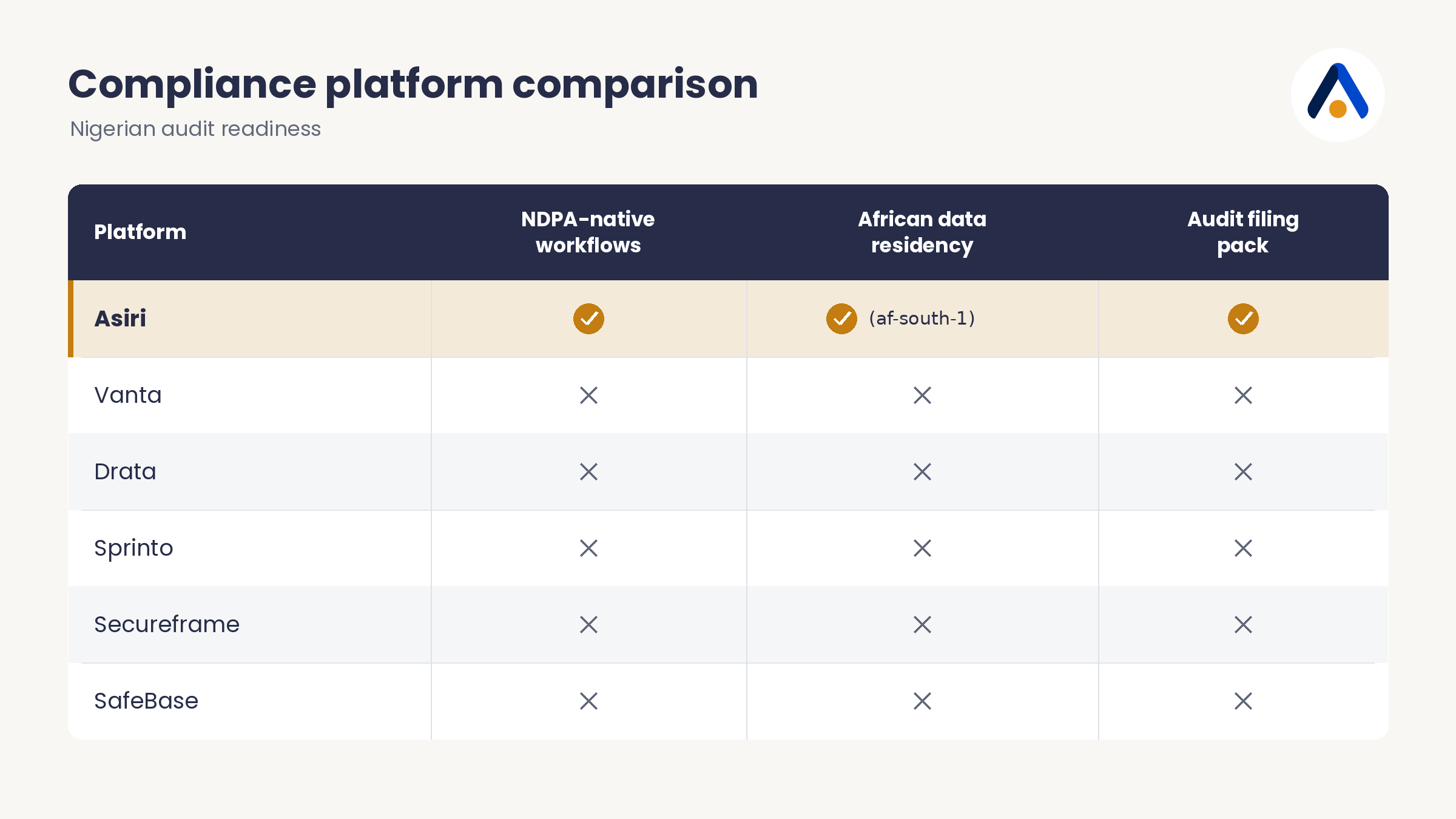
Comparison table: The best compliance platforms for Nigerian audit readiness
PlatformNDPA-native workflowsAfrican data residencyAudit filing pack
How does NDPA compliance affect vendor security reviews in Nigeria?
The Nigeria Data Protection Act 2023 requires every data controller and processor to demonstrate that personal data handling meets specific standards. When a Nigerian fintech runs a vendor security review, the reviewer is checking for lawful basis documentation, consent records, cross-border transfer safeguards, and evidence of breach notification readiness.
Vendor security reviews under the NDPA go beyond checking for a generic compliance badge. The reviewer needs to see that your registers are current, that your evidence links back to actual system reads, and that your licensed DPCO has filed the annual registration renewal on time.
According to a 2025 report by 6Wresearch on Africa's enterprise GRC market, demand for GRC tools across the continent is growing as regulatory enforcement intensifies.
Asiri translates that regulatory complexity into operational workflows your team can act on, mapping each NDPA requirement to specific controls and evidence.
What should Nigerian fintech teams look for in a compliance evidence platform?
Your first filter is whether the platform treats the NDPA as a primary framework or an afterthought. A platform that starts from GDPR and adds a Nigerian label swap will miss the specifics of the Act.
Those specifics include the DPCO licensing requirement, the annual registration renewal cycle, the NDPC's own scoring methodology, and the statutory 72-hour breach notification window.
Data residency matters. If your compliance records sit in Ireland or Virginia, you face the same cross-border transfer question you are trying to document for your regulators. A platform that keeps records in af-south-1 (Cape Town) removes that issue from the audit conversation.
Evidence provenance is the third filter. Asiri distinguishes between verified reads, declared values, and missing evidence. That transparency turns your compliance evidence into something an auditor can trust.
Why Asiri is the best compliance hub for Nigerian audit readiness
Asiri was built for the law Nigerian teams are actually governed by. Every register, workflow, and filing pack maps to the NDPA, and the same evidence satisfies SOC 2 Type II, ISO 27001, and GDPR without duplicating work.
Asiri gives you audit-ready evidence with provenance for every figure. When your DPCO opens the filing pack, the working papers read themselves out of your registers.
Gaps show up in the audit file before they show up in front of the regulator. That preparation shortens your audit timeline and reduces the cost of every compliance engagement.
The platform is priced in naira against the NDPC's own data controller tiers. The free plan includes the core register, a Trust Center, and three seats.
If you hold personal data and someone you want to sell to, raise from, or answer to cares how you handle it, Asiri exists to help you prove that trust on your own terms. Prove trust, from Nigeria to the world.
FAQs about compliance evidence management for Nigerian teams
What is compliance evidence management?
Compliance evidence management is the process of collecting, organizing, and storing proof that your data protection controls operate as documented. Asiri automates this by connecting to your existing systems and pulling evidence with timestamps and provenance markers.
Do Nigerian fintechs need NDPA-specific compliance software?
Yes. The Nigeria Data Protection Act 2023 introduces requirements that generic compliance platforms do not cover, including DPCO-filed annual registration renewals, the NDPC's 100-point scoring scale, and specific cross-border transfer documentation. Asiri maps these obligations directly into your compliance workflows so nothing falls through the cracks.
Can one platform cover NDPA, SOC 2, and ISO 27001 at the same time?
Yes. Asiri manages seven frameworks and maps evidence requirement by requirement across NDPA, SOC 2 Type II, ISO 27001, ISO 42001, PCI DSS, ISO 27701, and GDPR. You collect evidence once and satisfy multiple frameworks without rebuilding your controls for each standard.
What is a Trust Center and why does it matter for vendor reviews?
A Trust Center is a public or gated web page where you publish your security posture and compliance documentation. Asiri generates your Trust Center from the registers you already maintain, so the information stays current.
Buyers and procurement teams use it to complete security reviews without emailing your team for every document.
Where does Asiri store compliance data?
Asiri keeps every register in af-south-1 (Cape Town). For a product about cross-border discipline, hosting compliance records in an African region means your own data residency question is already answered when a regulator or buyer asks.
About the author

Abraham Esandayinze Tanta
Founder/CEO
Founder, Asiri — compliance infrastructure for Nigeria's NDPA · Creator of ndpr-toolkit (open source) · Security engineering → privacy tooling
Ready to put the ideas into practice? Try the readiness check.