
Check whether claims connect to evidence
Each public claim should map to a source record, owner, review date, and evidence artifact. If a platform cannot show that link, the Trust Center becomes marketing copy instead of proof.
A Trust Center should not be a pretty page with unsupported claims. It should connect public trust signals, gated evidence, review history, access approvals, and NDPA operating records.

Trust Center software evaluation guide
Founders, Enterprise sales, Security leads, DPOs, Procurement teams
8 proof types mapped
Owner, cadence, evidence, review, export
Many teams answer buyer diligence with copied PDFs, stale screenshots, and one-off email threads. Buyers need proof that is current, scoped, reviewed, and access-controlled.
Each public claim should map to a source record, owner, review date, and evidence artifact. If a platform cannot show that link, the Trust Center becomes marketing copy instead of proof.
Public pages can show framework status, policies, subprocessors, incident history, and contacts. Sensitive artifacts such as architecture notes, audit evidence, and security reports should require approval and logging.
For Nigerian teams, Trust Center software should connect to NDPA workflows: RoPA, DPIA, DSR, breach, vendor, transfer, policy, and CAR package evidence.
DPO / privacy lead
Shows that the control exists outside marketing copy and can be inspected by a buyer, DPCO, auditor, or regulator.
Create record, attach proof, assign reviewer, export pack.
Legal reviewer
Connects the obligation to a named owner, review date, and source record so the evidence does not go stale.
Set cadence, monitor freshness, escalate blockers.
Security owner
Provides a reusable artifact for procurement reviews, internal governance, and audit-readiness exports.
Map to control, preserve approval, publish bounded status.
Engineering owner
Shows that the control exists outside marketing copy and can be inspected by a buyer, DPCO, auditor, or regulator.
Create record, attach proof, assign reviewer, export pack.
Procurement owner
Connects the obligation to a named owner, review date, and source record so the evidence does not go stale.
Set cadence, monitor freshness, escalate blockers.
Executive sponsor
Provides a reusable artifact for procurement reviews, internal governance, and audit-readiness exports.
Map to control, preserve approval, publish bounded status.
DPO / privacy lead
Shows that the control exists outside marketing copy and can be inspected by a buyer, DPCO, auditor, or regulator.
Create record, attach proof, assign reviewer, export pack.
Legal reviewer
Connects the obligation to a named owner, review date, and source record so the evidence does not go stale.
Set cadence, monitor freshness, escalate blockers.
DPO / privacy lead
A current operating record with owner, date, and source evidence.
Legal reviewer
A reviewed artifact ready for buyer, DPCO, or management inspection.
Security owner
A remediation or approval trail that explains the decision taken.
Engineering owner
A current operating record with owner, date, and source evidence.
Procurement owner
A reviewed artifact ready for buyer, DPCO, or management inspection.
Executive sponsor
A remediation or approval trail that explains the decision taken.
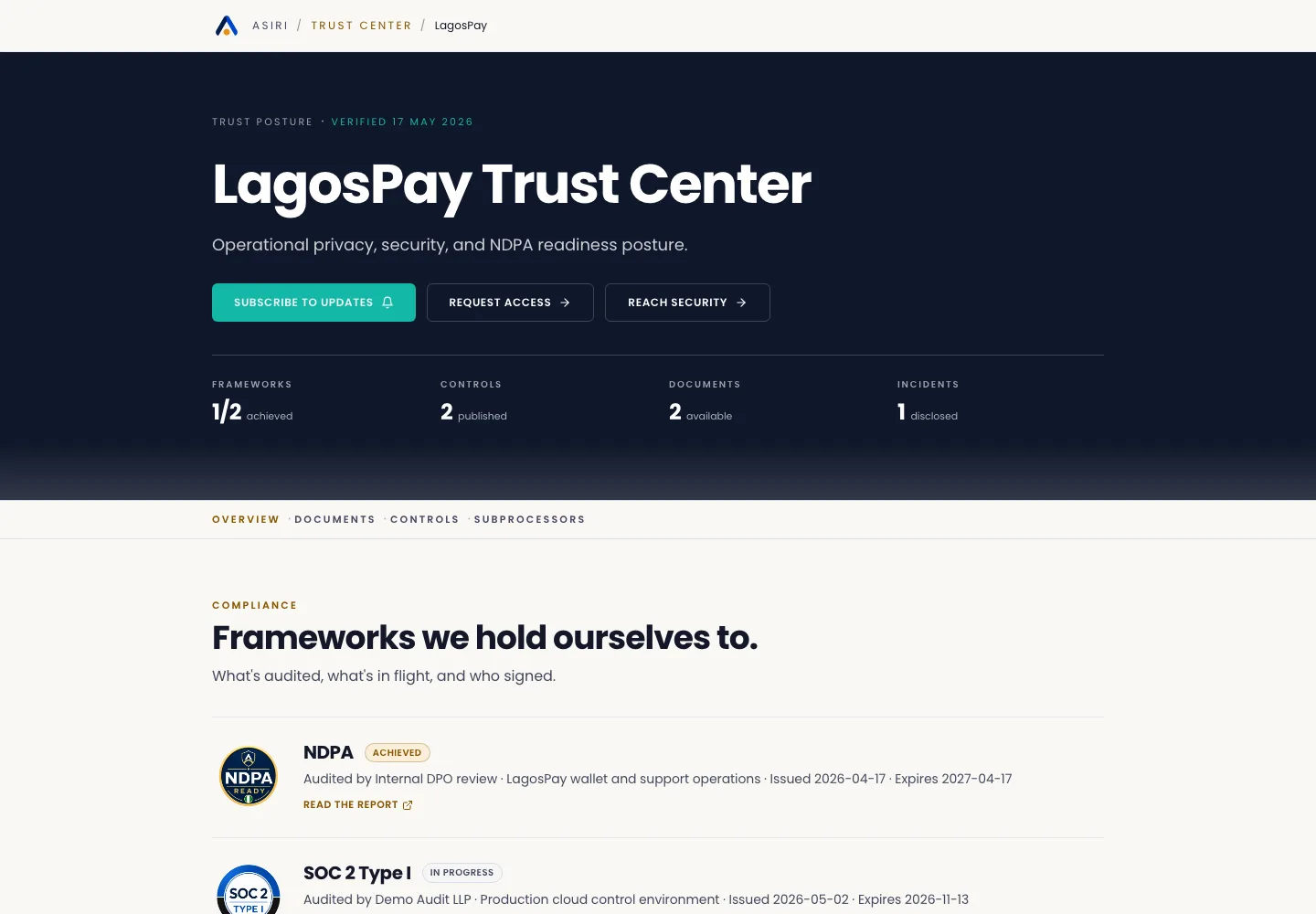
ASIRI helps your team move from knowing what to do to proving that the work is operating: records are assigned, evidence stays fresh, reviews are preserved, and audit-ready exports can be shared with buyers, DPCOs, management, or auditors.
These are the records a serious buyer, DPCO, auditor, or regulator will expect to see behind the claim.
ASIRI can organize workflows, evidence, review gates, and exports. Legal interpretation, regulator responses, DPCO submissions, and third-party certifications still require qualified human review and the relevant external authority.
Use it to brief your DPO, founder, procurement lead, or DPCO team on the evidence objects behind trust center software evaluation guide: owners, review dates, artifacts, blockers, and export expectations.
Asiri connects NDPA operations, evidence rooms, buyer access, and public Trust Centers so teams can prove trust without rebuilding diligence for every deal.
Credibility comes from source-linked claims, current evidence, reviewer history, access control, incident transparency, and clear separation between readiness and formal third-party attestations.
Yes, if the Trust Center clearly separates formal certifications from readiness evidence, in-progress controls, policies, subprocessors, incident history, and gated proof.